




Bioequivalence in Türkiye: A Scientific Safeguard or an Administrative Formality?
A critique of a system that has slipped from binding regulation to guideline, that is not independently verified, and that offers no transparency
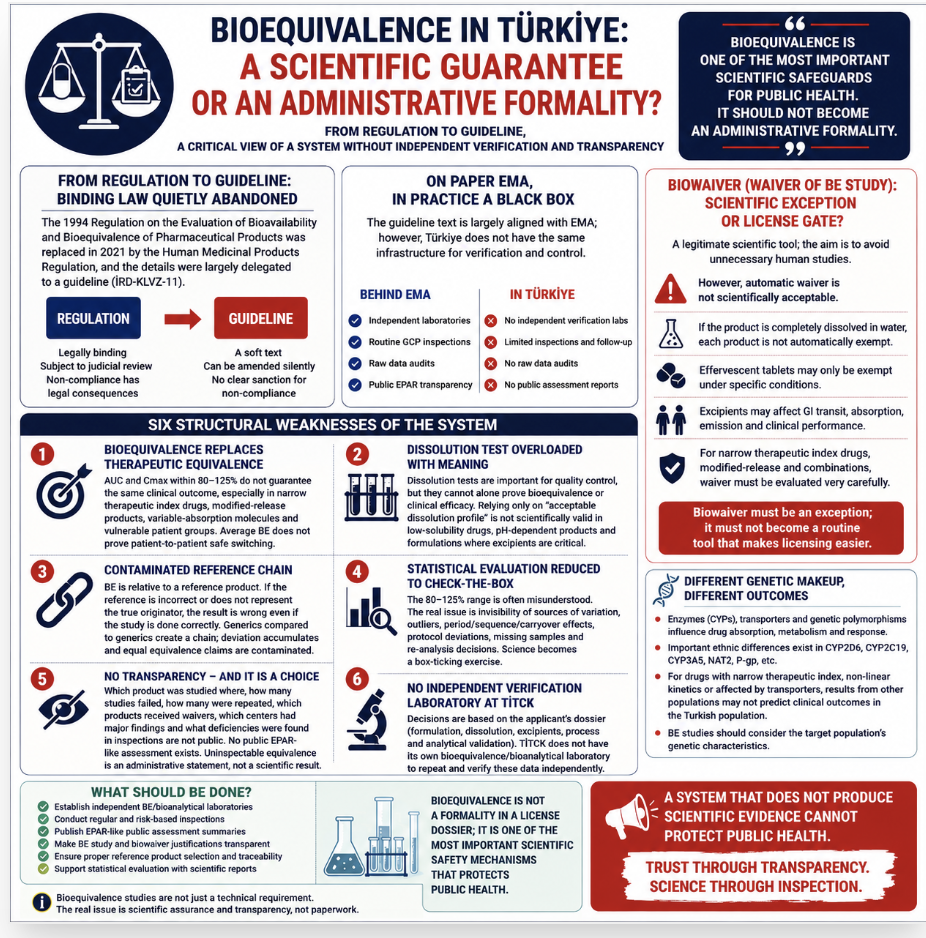
From Regulation to Guideline: The Quiet Abandonment of Binding Law
Türkiye no longer has an independent, binding regulation dedicated to bioavailability and bioequivalence. The 1994 Regulation on the Assessment of the Bioavailability and Bioequivalence of Pharmaceutical Preparations served as the core instrument for many years. Since the Regulation on the Licensing of Medicinal Products for Human Use came into force in 2021, however, the substance of bioequivalence assessment has largely been delegated to a guideline (İRD-KLVZ-11).
This is not a technical detail; it is a deliberate loosening of accountability. A regulation is a binding administrative act: it is subject to judicial review, its amendment requires due process and transparency, and its violation carries consequences. A guideline, by contrast, is a soft instrument that the administration can revise quietly with the stroke of a pen and whose breach carries no clear sanction. Moving the very threshold that decides whether a generic is deemed 'the same' as the originator from binding law into an administrative guideline places a decision affecting millions of patients at the discretion of the administration. The question is plain: is it sufficient for a field that forms the scientific and legal foundation of licensing to be governed largely by a 'guideline'?
EMA on Paper, a Black Box in Practice
On paper, Türkiye's BA/BE system looks close to international standards, because the guideline text largely follows the EMA bioequivalence guideline (CPMP/EWP/QWP/1401/98 Rev.1). But copying a text and possessing the capacity to enforce it are two entirely different things. Behind the EMA stand independent bioanalytical laboratories, routine GCP inspections, raw-data audits, and the transparency of a European Public Assessment Report (EPAR) published for every product. Türkiye adopted the sentences of the guideline but not the inspection and verification architecture behind them. What was imported, therefore, is not the standard itself but the claim that the standard is being applied.
Six Structural Fault Lines
1. Bioequivalence is being substituted for therapeutic equivalence
This is the most fundamental conceptual error. Two products whose AUC and Cmax fall within the acceptance range are not thereby guaranteed to produce the same clinical outcome — particularly for narrow-therapeutic-index drugs, modified-release preparations, molecules with variable absorption, and critical patient groups. The system knows this distinction in theory, yet in practice the bioequivalence result is used as though it were a 'certificate of clinical equivalence.' Average bioequivalence does not prove safe patient-to-patient switchability; papering over that gap with an administrative stamp of 'equivalent' dilutes the concept itself.
2. Dissolution testing is asked to carry a meaning it cannot bear
Dissolution and disintegration tests are valuable for quality control, but on their own they demonstrate neither bioequivalence nor clinical effect. The shortcut of 'if the dissolution profile matches, there is no problem' is scientifically indefensible for poorly soluble drugs, substances with pH-dependent dissolution, formulations in which excipient effects are decisive, and modified-release products.
3. The reference-product chain is contaminated
Equivalence is always relative to a reference; therefore, if the reference is wrong, even a study conducted 'correctly' against it is ultimately wrong. In Türkiye it is often not transparent whether the chosen reference is identical to the true originator, whether it represents the actual clinical reference on the market, and how differences between imported and local references are managed. As generic is benchmarked against generic in a chain, deviation from the original accumulates; and once the reference chain is contaminated, every equivalence claim resting on it is contaminated too.
4. Statistical assessment is reduced to ticking a box
The 80.00–125.00 acceptance range is frequently misread by the public as 'a 20% difference is allowed,' whereas it is in fact a statistical decision based on the confidence interval of log-transformed parameters. The real problem is that this nuance disappears: sources of variability, outliers, period/sequence/carry-over effects, protocol deviations, missing samples, and re-analysis decisions remain invisible. When the assessment is reduced to 'did it fall within 80–125?', scientific judgment collapses into the ticking of a statistical box.
5. There is no transparency — and this is a choice, not an accident
This is perhaps the gravest problem. In Türkiye it is not public which product was studied at which centre, how many studies failed, how many were repeated, which products received biowaivers, which centres received serious findings, and what deficiencies inspections identified. While the EMA publishes an EPAR for every product, TİTCK has no equivalent publicly available assessment summary. Without inspection outcomes, centre performance, and failed-study data, the reliability of the system cannot be evaluated independently. An equivalence that cannot be audited is not a scientific result but an administrative assertion.
6. TİTCK has no verification laboratory of its own
Bioequivalence and biowaiver decisions rest essentially on the dossier submitted by the applicant: formulation, dissolution profiles, excipients, manufacturing process, and analytical validation are reviewed. Yet TİTCK has no bioequivalence or pharmaceutical-performance laboratory of its own in which it could independently reproduce these data or re-measure bioanalytical samples. Assessment proceeds through the dossier plus, where necessary, on-site GMP inspection. That a critical decision rests solely on the applicant's declaration is a structural weakness.
Biowaivers: A Scientific Exception or a Licensing Shortcut?
A waiver from the bioequivalence study is a legitimate scientific tool long used by the EMA, the WHO, and other authorities; its purpose is to avoid unnecessary human studies where they would add no information. The problem is not the tool itself but the scientific justification on which it is granted and the level of independent verification behind it.
Take effervescent products: if, upon administration, the active substance is fully in solution and the test and reference present the same active substance at the same concentration, the EMA may not require an in vivo study for certain oral-solution types. But the EMA also states that a study is required if excipients may affect gastrointestinal transit, absorption, solubility, or stability. The reasoning 'it is effervescent, therefore no BE is needed' is thus scientifically wrong. The right questions are: does the same solution truly form on administration, does it empty from the stomach at the same rate, does it create the same pH and ionic environment, does it carry the same excipient load?
For fixed-dose combinations the problem grows. In an effervescent combination such as diclofenac + codeine there is not a single simple molecule but an NSAID together with an opioid prodrug; sodium bicarbonate, citric/tartaric acid, buffer capacity, pH shift, osmolarity, and possible sorbitol/mannitol may affect gastric emptying and absorption. Moreover, if no approved originator oral solution exists, there is no true clinical reference against which the 'it turns into a solution' argument can be tested. Granting a waiver for such a product on the basis of an in vitro dissolution dossier alone is, for a systemically acting combination analgesic, inadequate as scientific assurance. In short: a waiver accepted under defined conditions at the EMA — can it be applied in Türkiye with the same independent verification and transparency? A waiver must remain a scientific exception; it must not become a routine gateway that eases licensing.
The Real Test: Bioequivalence Studies Conducted Abroad — Especially in India
A substantial share of bioequivalence studies is now performed at contract research organizations (CROs) abroad, above all in India. India is one of the world's largest generic manufacturers and hosts many high-quality centres. Yet the same India has, over the past decade, been among the countries most sanctioned by the FDA and the EMA for data-integrity and bioequivalence misconduct. And the common, sobering lesson of these cases is this: the fraud was never caught by dossier review — only by on-site inspection.
GVK Biosciences (Hyderabad). An inspection by the French agency (ANSM) revealed that electrocardiogram (ECG) data in generic-drug studies had been systematically manipulated over a period of at least five years. The EMA's CHMP reviewed more than 1,000 pharmaceutical forms and strengths studied at the site; while roughly 300 products with sufficient data from other sources remained on the market, around 700 were recommended for suspension. The European Commission made the decision legally binding across the EU on 16 July 2015. The systematic nature of the manipulation, its duration, and the number of staff involved cast doubt on the reliability of all data generated at the site.
Semler Research Centre (Bangalore). An FDA inspection found that subjects' clinical samples had been substituted and manipulated; the WHO confirmed the same data-integrity problems in its own inspection and issued a Notice of Concern. On 21 July 2016 the EMA ruled that bioequivalence studies conducted at this centre could not be accepted in EU marketing-authorization applications and recommended suspension of the affected products. The FDA asked companies to repeat studies relying on Semler data. The affected products belonged to major firms including Sandoz, Teva, Mylan, Sanofi, Glenmark, and Accord — being a 'large, well-known company' is no guarantee.
Micro Therapeutic Research Labs (two sites). GCP inspections by the Austrian and Dutch authorities in February 2016 identified misrepresentation of study data and deficiencies in documentation and data handling. In 2017 the EMA concluded that data generated at these sites between June 2012 and June 2016 were unreliable and could not support EU authorization. Similarly, dozens of products relying on other Indian CROs, such as Synchron Research, were suspended by the EMA.
Ranbaxy (historical precedent). In 2013 Ranbaxy pleaded guilty in the United States to systematic data fraud — including bioequivalence and stability data — and signed a record 500 million USD settlement; the FDA barred imports from several of its facilities. This shows that the issue is not an isolated 'bad centre' but a structural data-integrity risk spread across the supply chain.
Here is the real question for Türkiye. None of these scandals surfaced through dossier review; every one was caught by foreign authorities' on-site inspection, by examining raw data and retained samples. Türkiye's approach to foreign BE studies, by contrast, rests mainly on dossier-based assessment. So: are some of the products studied at these centres and suspended in the EU present on the Turkish market, and if so what became of them? When the EMA or the FDA invalidates an Indian CRO, does TİTCK systematically track this and re-evaluate Turkish authorizations resting on the same studies? There is no publicly available answer. The assurance lies not in the country where a study was performed but in the independent inspection mechanism by which it was verified; and relying on the dossier alone can, as GVK and Semler show, keep systematic fraud invisible for years.
Same Molecule, Different Population: The Problem of Ethnic and Genetic Generalizability
Bioequivalence studies are mostly conducted in healthy volunteers, on the assumption that two products containing the same active substance will behave similarly across different populations. This assumption is often defensible, because what is measured is not the absolute value but the relative difference between test and reference. But it does not hold for every drug. Polymorphisms in enzymes such as CYP2D6, CYP2C9, CYP2C19, CYP3A5, NAT2, and UGT, and in transporters such as P-glycoprotein (ABCB1), significantly alter absorption, metabolism, and elimination. For example, the CYP2C19 poor-metabolizer phenotype occurs in 15–20% of East Asian populations versus 2–5% in Europeans; CYP3A5 expression is far higher in individuals of African ancestry.
Türkiye is a heterogeneous society at the crossroads of European, Middle Eastern, and Central Asian populations. Consequently, the generalizability of data obtained in India, China, or Northern Europe to the Turkish population is not the same for every drug. The risk rises particularly for drugs that:
– exhibit non-linear pharmacokinetics
– have a narrow therapeutic index
– undergo polymorphic metabolism
– are affected by transporter proteins
– show saturable metabolism
– whose active metabolites are decisive for therapeutic effect
Codeine is the textbook example: it is a prodrug converted to morphine via CYP2D6, and genotype differences can carry the same bioequivalence study to different pharmacodynamic outcomes in different populations. Clopidogrel, omeprazole, tacrolimus, phenytoin, and warfarin are similarly genotype-sensitive. The conclusion is not to treat foreign studies as automatically invalid; but neither can their results be applied to every population with the same level of confidence. The bioequivalence of the future will have to answer not only 'are the products equivalent?' but also 'equivalent in which population?'
Conclusion: An Unverified Promise
At the level of text, Türkiye's bioequivalence regime appears aligned with the international standard; in practice it has lost all four of its foundations: its binding force (from regulation to guideline), its independent verifiability (the absence of an own laboratory and of raw-data audits), its transparency (the absence of an EPAR-equivalent disclosure), and its alignment with external oversight (the failure to track the fate of studies declared invalid abroad). On top of this, a system once deceived by a fabricated bioequivalence dossier (the Allpharma case) has offered no public evidence that it has structurally closed that gap.
Bioequivalence is not a formality in a licensing dossier; it is one of the most important scientific filters protecting public health. For it to work as a filter, reference selection, study design, statistical analysis, laboratory inspection, biowaiver decisions, and failed studies must be publicly traceable. Otherwise the phrase 'bioequivalent' remains not a demonstrated scientific fact but an unverified administrative promise — and the cases from GVK to Semler show clearly who pays the price of a promise left unverified.
References
1. European Medicines Agency. GVK Biosciences — Article-31 referral: confirmation of recommendation to suspend medicines over flawed studies. CHMP opinion 22 January 2015; re-examination 21 May 2015; European Commission binding decision 16 July 2015 (Directive 2001/83/EC). Amsterdam: EMA.
2. European Medicines Agency. EMA recommends suspension of medicines over flawed studies at Semler Research Centre. Press release, 21–22 July 2016. Amsterdam: EMA (following U.S. FDA inspection and WHO Notice of Concern regarding substitution and manipulation of subjects' samples).
3. European Medicines Agency. EMA recommends suspension of medicines due to unreliable studies from Micro Therapeutic Research Labs. 2017; data generated June 2012 – June 2016 deemed unreliable. Amsterdam: EMA.
4. European Medicines Agency. Synchron Research Services — Article-31 referral (flawed bioequivalence studies). Amsterdam: EMA. [Decision date to be confirmed by the author.]
5. U.S. Department of Justice / U.S. Food and Drug Administration. Generic drug manufacturer Ranbaxy pleads guilty and agrees to pay 500 million USD. Press release, 13 May 2013.
6. European Medicines Agency, CHMP. Guideline on the Investigation of Bioequivalence. CPMP/EWP/QWP/1401/98 Rev. 1/Corr. London: EMA; 2010.
7. World Health Organization. Notice of Concern: Semler Research Center Private Limited, Bangalore, India. Geneva: WHO Prequalification Programme; 12 April 2016.
8. U.S. Food and Drug Administration. Untitled/Warning Letter, Semler Research Center Private Limited. Silver Spring, MD: FDA; 2016.
9. Ministry of Health of Türkiye, Turkish Medicines and Medical Devices Agency (TİTCK). Regulation on the Licensing of Medicinal Products for Human Use. Official Gazette, 11 December 2021, No. 31686.
10. Turkish Medicines and Medical Devices Agency (TİTCK). Guideline on the Investigation of Bioavailability and Bioequivalence of Medicinal Products for Human Use (İRD-KLVZ-11). Ankara: TİTCK. Yürürlük Tarihi 15/11/2022