



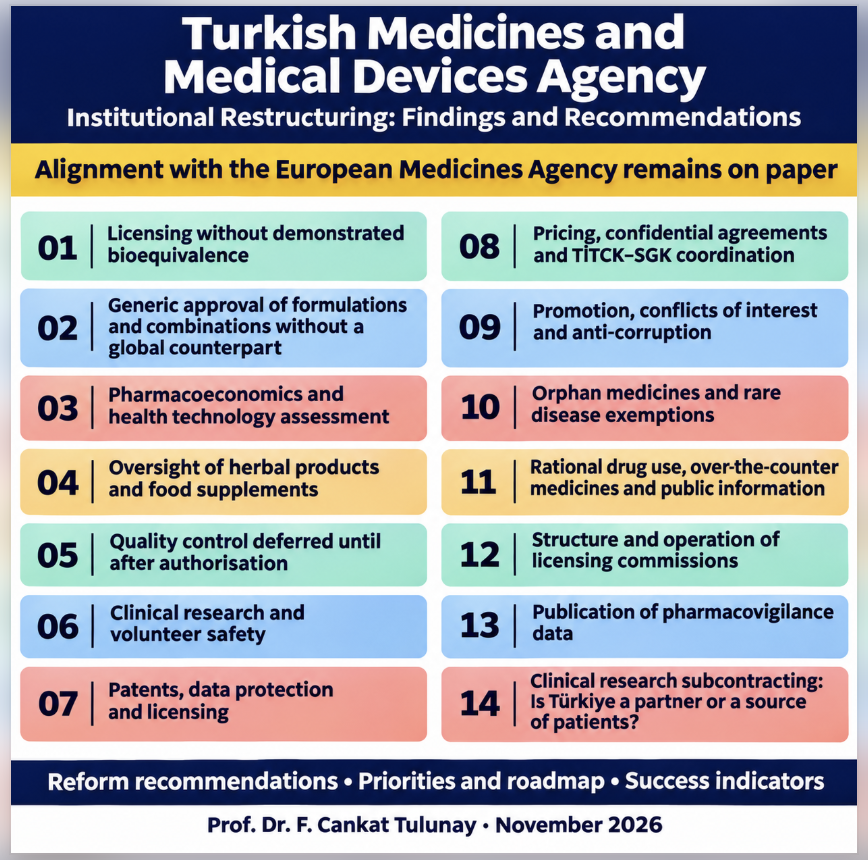
Below is the executive summary of my advisory report “TİTCK Institutional Restructuring: Findings and Recommendations”, submitted to the Presidency of the Turkish Medicines and Medical Devices Agency (TİTCK). The report is based on publicly available sources and on my articles published at klinikfarmakoloji.com. The full report (41 pages, PDF) is attached at the end of this article.
Executive summary
TİTCK’s most fundamental problem is that alignment with the EU and the EMA has remained on paper: the regulatory texts have been adopted, but the independent verification, inspection and transparency architecture that makes those texts work has not been built. The Agency has been a member of PIC/S since 2018 and of ICH since 2020; yet it has had 8 presidents since 2012, it has not achieved WHO Listed Authority status, and of the 167 new medicines approved in the EU in 2019–2022 only 4% have entered public access for Turkish patients.
This note addresses different faces of the same problem in four areas. At the licensing stage: generics whose bioequivalence has not been demonstrated (including the Allpharma case, in which 137 falsified dossiers went unsanctioned), acceptance as generics of combinations that have no counterpart anywhere in the world, and licensing commissions whose membership, interests and procedures are unknown. After licensing: quality control left to the company’s declaration, pharmacovigilance data that never returns to Turkish physicians, and suspension decisions abroad that are not followed up. In pricing and reimbursement: pharmacoeconomics that exists only on paper, pricing rules whose rationale is not disclosed, and a reimbursement list shaped by court rulings. In the market and in research: an uncontrolled supplement market, invisible industry payments, and the use of Türkiye in multicentre trials not as a scientific partner but as a source of patients for foreign companies.
The recommendations share a single criterion: not asserted trust, but demonstrable trust. Most of them can be launched without waiting for legislative change, by decision of the Presidency and within the first six months; only structural items such as the president’s term of office, a separate personnel regime for experts, an independent HTA body, the transfer of health-related foods to the Agency and the change of the Agency’s name require a law or a Presidential Decree.
12 priority recommendations
1. Put EMA alignment into practice: a public assessment report similar to the EPAR for every new marketing authorisation; re-evaluation in Türkiye, within 90 days, of EMA/FDA suspension decisions. (Main theme)
2. Return bioequivalence to binding law and build independent bioanalytical verification capacity. (Section 1)
3. Require full or hybrid applications for combinations and formulations without a reference product; re-evaluate within 24 months the products licensed only in Türkiye. (Section 2)
4. Re-establish the licensing commissions: a regulatory basis, selection by open call, 3-year terms, published declarations of interest, assessment by two rapporteurs, and reasoned opinions with dissenting votes recorded. (Section 12)
5. Verify quality instead of assuming it: risk-based pre-authorisation testing, an annual market sampling programme, batch verification of raw materials. (Section 5)
6. Publish pharmacovigilance data: an annual TÜFAM (Turkish Pharmacovigilance Centre) report and a public Turkish-language portal by active substance. (Section 13)
7. Independent health technology assessment (HTA) and an explicit cost-effectiveness threshold. (Section 3)
8. The EU “rule of doubt” for supplements: a product that is in substance a medicine should be regulated as a medicine; health-related foods should be brought under the TİTCK umbrella and the Agency’s name changed accordingly. (Section 4)
9. Make Türkiye a partner in clinical research: a binding KAP (Turkish clinical trials portal) registration, contractual guarantees of authorship for Turkish investigators, reporting of Turkish patient data to TİTCK. (Sections 6, 14)
10. Binding transparency of industry payments: a Sunshine-type payments database and disclosure of funding by patient associations. (Section 9)
11. Count the licensing clock from submission and publish actual timelines every quarter. (Reform recommendations, 3)
12. A fixed term for the president, a separate personnel regime for expert staff and a WHO WLA roadmap. (Reform recommendations, 1, 8, 10)
Türkçe sürüm: TİTCK’nin Kurumsal Yeniden Yapılanması: Tespitler ve Öneriler
AI support was used in the preparation of this article.
Ekler