
AIFD's "We Can't Access Innovative Drugs" Discourse: Emotional Exploitation or Institutional Pressure?
Is AIFD (The Association of Research-Based Pharmaceutical Companies) Engaging in Emotional Exploitation?
When an association spokesperson says "a country of 90 million, an advanced health system — of course price matters," they are actually selling two things: a diagnosis and a solution. The diagnosis is simple: we can't access. The solution is simple: raise the price. Between the two sits a box that never gets opened: how much these drugs actually work.
The Association of Research-Based Pharmaceutical Companies (AIFD) has operated in Turkey since 2003 as the umbrella organization for multinational patented drug manufacturers. On its corporate website it describes its mission as "ensuring Turkish people's access to new and original medicines" — a trade association translating its own members' product sales into the language of a humanitarian mission is a rhetorical technique common in lobbying activity. The problem is not the technique itself, but that it is carried, unquestioned, by journalism, academia, and public institutions.
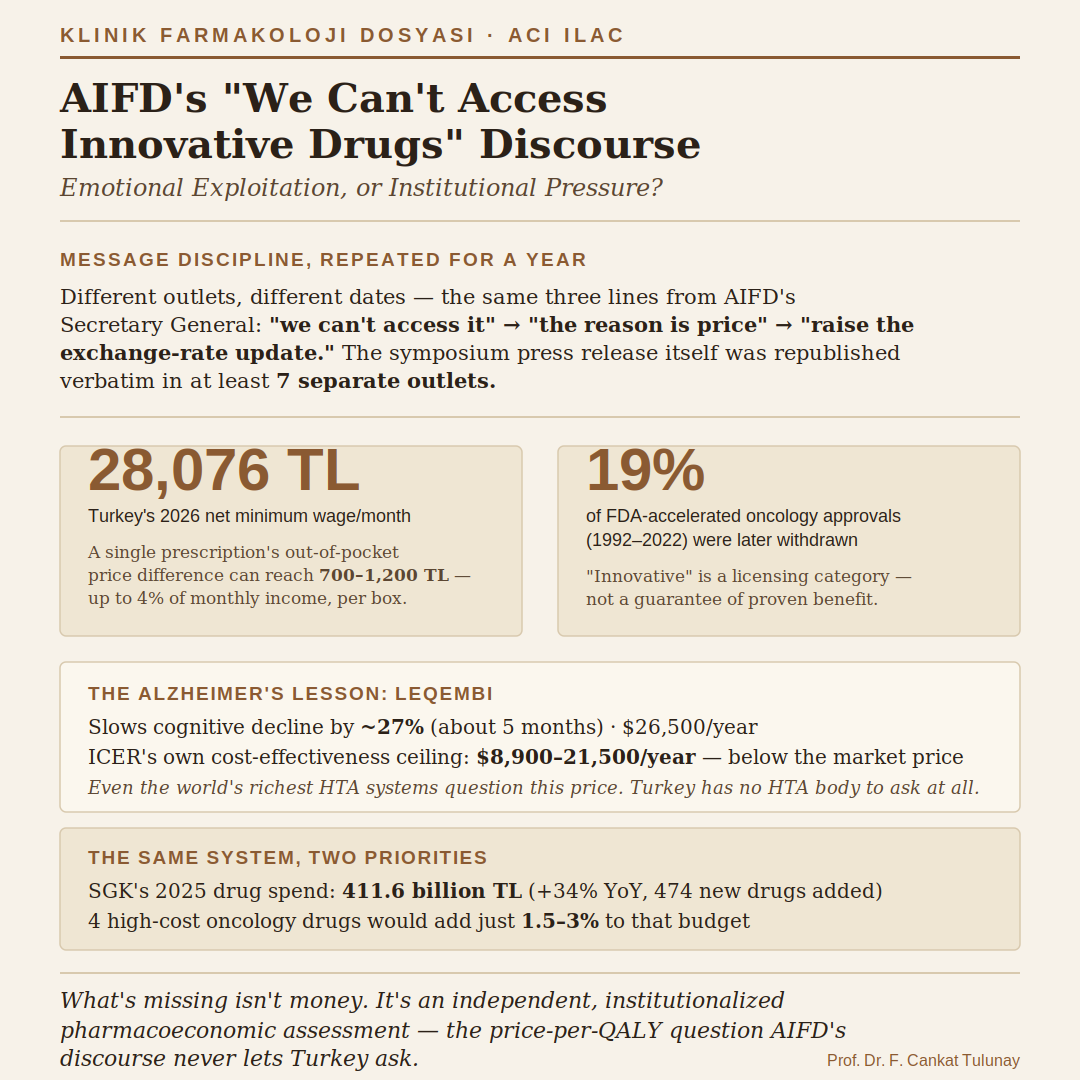
Placing Secretary General Ümit Dereli's interviews from the past year side by side reveals a pattern. In Ekonomi Gazetesi (December 2024): "In the short term, we requested that the current exchange-rate adjustment, still at 60 percent, be raised back to 70 percent as before, with two updates during the year." On Winally.com: "Drug Spending Is Not a Cost, It Is an Investment in Society's Future." In Nefes Gazetesi (August 2026): "The price is high, we can't access innovative medicine." Different outlets, different dates, the same three sentences: we can't access, the reason is price, the solution is an exchange-rate update. This is not a news flow — it is message discipline, a textbook example of corporate communications.
The problem is not the message itself, but that nowhere is the question ever asked: which drug provides how much benefit, for how many lira? Instead, the equation "innovative drug equals hope" is constructed, and this equation is consumed without ever being questioned.
The Co-Payment Wall: The Mathematics of Buying Medicine on Minimum Wage
While reading AIFD's access lament, one also has to look at the picture already facing the retiree and the minimum-wage earner living in the same country, for ordinary licensed, reimbursement-listed drugs they already pay for. As of 2026, the net minimum wage is 28,075.50 lira (gross 33,030 lira). A co-payment of 10 percent applies to retirees and 20 percent to employees on prescription drugs; on top of this comes a separate "prescription fee" per prescription (3.76 lira for up to 3 boxes, 1.25 lira for each additional box) and the "drug price difference," the gap between SGK's reference price and the pharmacy sale price — which comes entirely out of the patient's pocket.
Examples compiled from complaint platforms show this is not an abstract issue. One patient paid 1,200 lira in December 2024 for 3 boxes of a prescribed drug; while the drug's co-payment-free price was 352 lira, an extra 847 lira was collected as a price difference — a chronic expense that recurs monthly. Another patient paid a 717 lira co-payment, then was asked for another 1,000 lira a week later due to a systemic error. Retiree associations have for years demanded the removal of drug co-payments for retirees, widows, and orphans; it is self-evident what it means for someone receiving a widow's or orphan's pension of 3,900–10,000 lira to pay 700–1,200 lira for a single prescription.
Let's put this picture next to AIFD's demand. On one side, a system in which a minimum-wage earner loses 3–4 percent of their monthly income on a single prescription; on the other, a discourse in which an association spokesperson demands raising the exchange-rate update from 60 to 70 percent, framing as a humanitarian necessity the inclusion, in reimbursement coverage, of treatments costing 1.5–2.3 million lira per person per year (65–80 times the minimum wage). These two realities live inside the same budget, the same SGK, the same country; in none of AIFD's statements are the two ever mentioned together.
The Fallacy of "Innovative Drug Equals Life-Extending Drug"
AIFD's 2022 Innovative Drugs Symposium press release contains this sentence: "While the average life expectancy was 45 years in the 1900s, it has now reached an average of 80 years thanks to the impact created by innovative treatments." This sentence contradicts basic public health history. The bulk of the life-expectancy leap between 1900 and 1950 is explained by sewer systems, clean water, vaccines, antibiotics, and the drop in infant and child mortality — not by the patented, high-priced molecules that fall into today's "innovative drug" category. The contribution of oncology and biotechnology drugs is real and significant, but attributing the entire leap to this category is a marketing sentence that ignores basic epidemiology.
More serious is this: the "innovative drug" label is not a quality guarantee, it is a licensing category; it means a patented molecule without prior precedent, not proven superior benefit. Of the 167 oncology indications the FDA granted accelerated approval to between 1992 and 2022, 31 — 19 percent — were later withdrawn because confirmatory trials failed to show the expected survival benefit. Bevacizumab (Avastin) was withdrawn from its breast cancer indication in 2011. Atezolizumab (Tecentriq) — a drug SGK currently does not reimburse at all — was voluntarily withdrawn by Roche from its second-line bladder cancer indication after it failed to show a survival benefit. Melphalan flufenamide (Pepaxto, 2024), mobocertinib (Exkivity, 2023), and umbralisib (Ukoniq, 2022) were all approved under the innovative label and all collapsed in confirmatory trials. In 2021 alone, 10 separate oncology indications failed to confirm clinical benefit; one study found that Medicare spent 46 million dollars in 2018–2019 alone on an unconfirmed indication of atezolizumab — public money going toward a treatment with unproven benefit.
The claim that innovative drugs extend human life is therefore a hasty generalization. Some innovative drugs genuinely extend survival — Enhertu and DESTINY-Breast04 are solidly evidenced examples; some are approved on surrogate endpoints and later collapse; some have already been partially withdrawn. Filing all of them under the "hope we can't access" category makes pharmacoeconomic evaluation impossible from the outset.
Are the Press and Scientific Associations Being Used for AIFD's Propaganda?
To answer this question it is enough to look at the events AIFD organizes itself. The AIFD Innovative Drugs Symposium is an annual event, first held in 2022 at Hacettepe University's Sıhhiye Campus, the second in 2024. The theme of the second symposium was "Value-Based Pricing and Reimbursement Systems." The speaker list is notably prestigious: Prof. Lieven Annemans of Ghent University on "A Global Look at Value-Based Systems"; Health Technology Assessment international (HTAi) President Rabia Sucu on "Examples of Value Measurement Methods"; former Deputy Minister of Health Prof. Sabahattin Aydın on "The Current Situation in Turkey"; and, on the same panel, Assoc. Prof. Eren Usul, General Director of General Health Insurance, who effectively runs SGK's reimbursement decisions.
It is worth pausing here: at an event organized by a trade association, the general director of the very public institution that association negotiates prices with takes the stage as a speaker. This brings together, on the same stage, the public authority's implicit endorsement, academia's scientific framing, and the legitimacy of the international HTA community — all lending support to AIFD's demand for value-based pricing, which is in effect a demand to be paid more. Less a scientific discussion platform than a stage where AIFD harvests institutional legitimacy for its own demand.
Nor is it a single instance. According to AIFD's own news items, the topic of "patient access to breakthrough treatments" was also addressed at the EAACI 2026 Annual Congress, the independent scientific congress of the European Academy of Allergy and Clinical Immunology. That an industry association's access-and-pricing framing found its way onto the agenda of an independent medical specialty congress with limited relevance suggests this is not an isolated case but part of a pattern in which the industry's message seeps into the podiums of scientific associations.
The press-side pattern needs to be handled in two layers, according to the level of evidence. What is verifiable: AIFD's symposium press release was published — word for word, in the same paragraph order, with the same quotations — in at least seven separate outlets (aifd.org.tr, medimagazin.com.tr, marjinal.com.tr, winally.com, saglikliturkiye.org, tibbinustalari.com, fikirliderleri.com). In this practice, known in journalism as churnalism, an institution distributes a text and outlets print it unchanged or with minimal editing. Likewise, Ümit Dereli repeats the same three messages across different outlets on different dates — a standard corporate communications discipline.
The fact that in the recent Nefes Gazetesi interview no counter-argument from a pharmacoeconomist, an independent HTA expert, or SGK appears at all shows the interview to be a one-sided transfer of information.
Budget Impact: How Many Patients, How Many Lira?
SGK does not publish an official budget-impact analysis; this is itself a transparency problem. The table below is a journalistic estimate built on publicly available price data and rough epidemiological assumptions; it does not rely on TİTCK's or SGK's actual patient records, and its purpose is only to indicate an order of magnitude.
Drug | Active ingredient / indication | Annual per-patient cost | Rough patient estimate | Annual budget impact |
Enhertu | Trastuzumab deruxtecan, HER2+ metastatic breast cancer | 1.9–2.3 million TL | 300–800 | 0.6–1.8 billion TL |
Tecentriq | Atezolizumab, bladder/lung/liver/breast (multiple) | 1.5–1.8 million TL | 1,000–2,000 | 1.8–3.6 billion TL |
Keytruda (expanded) | Pembrolizumab, 3 additional unreimbursed indications | 1.1–1.4 million TL | 2,000–4,000 | 2.4–4.8 billion TL |
Zejula | Niraparib, ovarian cancer maintenance | 1–1.4 million TL | 800–1,500 | 1–2 billion TL |
Total (four drugs) | approx. 6–12 billion TL/year |
SGK's total drug spending in 2025 was 411.6 billion lira, up 34 percent from the previous year. Full reimbursement coverage of these four drugs would mean an additional burden of about 1.5–3 percent of the total drug budget — large, but not a system-collapsing figure. SGK already added 474 new drugs to the reimbursement list in 2025, and total health spending rose 38 percent, from 980.9 billion to 1 trillion 353.1 billion lira.
The real contradiction here is this: while the overall system can relatively absorb an addition of this size, that same system cannot prevent the minimum-wage earner from paying a 700–1,200 lira price difference for a single box of medicine. It is clear where the resource-allocation preference is going; the system opens itself up to large, expensive, and uncertain-outcome innovative drugs while insisting on small but mass-scale burdens in everyday, chronic medications. This is not a capacity problem — it is a prioritization choice; and AIFD's discourse does not call for this choice to be questioned, but for the scope to be expanded even further.
Note — transparency about the budget-impact methodology: The patient-number estimates in this article (ranging from 300 to 4,000) are the author's rough assumptions, not based on official epidemiological records. The aim is not to claim a precise figure but to give a sense of the relative weight of this demand against the overall system size. A precise budget-impact analysis can only be produced using SGK's own patient records and TİTCK's epidemiological data; the fact that this is never done independently and transparently is itself one of this article's central criticisms.
Two Lessons from the World: Alzheimer's Drugs and Weight-Loss Drugs
Alzheimer's: Leqembi and Kisunla, 27% slowing and full price
Two breakthrough Alzheimer's drugs approved by the FDA in 2023–2024, lecanemab (Leqembi, Eisai/Biogen) and donanemab (Kisunla, Eli Lilly), were presented as the first drugs to clear the amyloid buildup underlying the disease. The real clinical picture is more modest. In its pivotal CLARITY-AD trial, Leqembi slowed cognitive decline by only about 27 percent over 18 months; in practice, patients reached the same level of cognitive loss roughly 5 months later. It does not stop or reverse the disease, only slows it. Kisunla showed a similar picture, with 22–36 percent slowing, closer to the upper bound in the earliest-stage patients.
The safety side is serious: in the Leqembi group, 17.3 percent (versus 9 percent on placebo) experienced brain swelling or bleeding (ARIA); in the Kisunla trials this rate reached as high as 30.5 percent, and three drug-related deaths were reported. On price, Leqembi costs roughly 26,500 dollars a year, Kisunla roughly 32,000 dollars; on top of this comes additional cost — up to 82,500 dollars a year — for genetic testing, amyloid-PET scanning, and regular MRI monitoring. ICER (the Institute for Clinical and Economic Review), an independent body, calculated in its own cost-effectiveness analysis that Leqembi could be reasonable in the 8,900–21,500 dollar/year range; the drug's market price exceeds even the upper bound of that independent assessment. ICER's chief medical officer put it plainly: above 10,000–15,000 dollars is not a reasonable place to be. Medicare is expected to spend 2–5 billion dollars a year on these two drugs — even though 90 percent of patients have already passed the early stage where the drug works by the time they're diagnosed.
This is the clearest example of why the narrative "innovative equals certain benefit, non-reimbursement equals tragedy" needs to collapse. Even the world's wealthiest systems with the most developed HTA capacity are questioning these drugs through their own independent bodies and finding the price excessive. Had Turkey had an HTA institution, it would likely have reached the same conclusion — not "we can't access it," but "we won't buy it at this price."
Weight-loss injections: a multibillion-dollar market, a treatment the patient pays for out of pocket
GLP-1 class drugs (semaglutide/Ozempic-Wegovy, tirzepatide/Mounjaro-Zepbound) are the fastest-growing segment of the global pharmaceutical market. In 2025 the GLP-1 receptor agonist market reached 66.4 billion dollars, and the obesity-only indication segment reached 8.2 billion dollars; 2035 projections range from 66 to 195 billion dollars. Total GLP-1 sales in 2025 were 132 billion dollars, up 33.5 percent from the previous year.
The effect is real but not unlimited. In clinical trials, patients lose 15–20 percent of body weight — a significant result, but not permanent: weight is largely regained once the drug is stopped, meaning lifelong treatment is required. In the US, fewer than 4 percent of the global obese population can access these drugs; roughly 28 percent of those using them for obesity discontinue treatment within a year.
A Diabetes Drug, a Weight-Loss Demand: An Unmonitored Drift: SGK's reimbursement of GLP-1 drugs solely for the type 2 diabetes indication creates, in practice, a hard-to-control open door. As elsewhere in the world, in Turkey too much of the demand for these drugs is now for weight loss; according to warnings from TÜBİTAK Bilim Genç and various health organizations, this intense demand has at times led to pharmacy stock shortages, real diabetes patients being unable to access the drug, and the spread of counterfeit or unregulated products online. Poison control hotlines report an increase in semaglutide-related calls, largely attributed to dosing errors and unsupervised use.
SGK needs to strengthen prescription and patient monitoring, both to protect diabetic patients according to their genuine needs and to prevent system abuse — through regular auditing of consistency between lab values (HbA1c, fasting blood glucose) and diagnostic reports, monitoring patterns such as an abnormally high volume of diabetes reports from the same physician or the same pharmacy, and sharing this data (aggregated, without personal information) with the public. Without a transparent oversight mechanism, it is impossible even to say "there is no abuse," let alone prove abuse — and that uncertainty is itself another reflection of TİTCK/SGK's lack of data transparency.
Note — a point requiring further evidence: There is a claim frequently voiced publicly but not directly documented in this investigation: that some patients or physicians obtain diagnostic reports for a diabetes diagnosis that does not actually exist, in order to benefit from SGK reimbursement. This is a claim that should be taken seriously, but as it stands it is not a confirmed finding — it is a subject for further investigation. Demonstrating the existence or scale of such abuse would require SGK's report and prescription audit data; this data is not publicly available.
Anatomy of a Pressure Campaign: Against TİTCK and SGK (Turkish Medicines and Medical Devices Agency ve Social Security Institution)
Placed side by side, what has been described so far are not scattered PR practices but the components of a coordinated pressure campaign.
- Message discipline: the same three sentences, the same spokesperson, across different outlets, repeated over months: we can't access, the reason is price, the exchange-rate update is needed.
- Press-release churnalism: symposium texts, copied verbatim across at least seven outlets, create the appearance of numerous news stories generated from a single source.
- Harvesting institutional legitimacy: by inviting to its own symposium the General Director of General Health Insurance who effectively runs SGK's reimbursement decisions, a former Deputy Minister of Health, and international HTA authorities, AIFD lends the appearance of public and academic endorsement to its demand for value-based pricing.
This legitimacy-harvesting runs deeper than it appears; it is not merely cooperation between separate institutions but an overlapping network of individuals. Mr. Haluk Özsarı, who chaired the value-based pricing panel at the AIFD symposium, is also Chairman of the Board of the Value-Based Health Association (DETESADER). According to both the association's own record and Özsarı's own statement in an interview with klinikiletisim.com, the board elected at the association's founding general assembly on September 30, 2022 also includes Ümit Dereli — that is, the very AIFD Secretary General who is the subject of this article. These two independent sources (the association's own record and its chairman's own statement) confirm the 2022 election outcome; whether the board still consists of the same names today is not known.
The same association's website records that current Minister of Health Prof. Dr. Kemal Memişoğlu was, before his appointment, a Founding Board Member of the association, and that current Deputy Minister of Health Dr. Şuayip Birinci is, by his own statement, a member of the association. So at least as of 2022, the picture was this: the AIFD Secretary General and the individuals occupying the posts to which TİTCK and SGK report were simultaneously present within the founding board, board of directors, and membership structure of the same association — an association that promotes exactly the value-based pricing agenda AIFD demands, and whose panels are chaired at AIFD's own symposia.
- A concrete, repeated demand: raising the exchange-rate update rate from 60 to 70 percent, with two updates a year — less a general access discourse than a direct, numerical bargaining demand aimed at SGK's pricing mechanism.
- A cross-sector alliance: AIFD, the association of multinational and patented manufacturers, and İEİS, the association of domestic and generic manufacturers — normally different interest groups — converge on the same exchange-rate and reference-price mechanism change, further evidence that the issue is not patient access but the sector's overall revenue mechanism.
Each of these is, on its own, a legitimate advocacy tool. But read together, they present the appearance of a pressure campaign aimed at TİTCK's licensing process and SGK's reimbursement and price negotiation, using the public, academia, and the press simultaneously. TİTCK's independent evaluation capacity and SGK's price-negotiation authority are left working under the constant, disciplined message pressure of a single side with a far larger corporate communications budget. In return, there is almost no public communication of the same intensity from TİTCK or SGK — no "here is why we are not paying this price" statement; the asymmetry is not only financial but also communicative.
Conclusion: What's Missing Is Pharmacoeconomics
What AIFD is demanding is, in itself, a legitimate defense of interest; every trade association defends its members' income — this is normal. The problem is that this defense is presented within a moral and emotional frame — access to life-extending innovative medicine — and never turns into the question of how many lira per QALY this drug is worth.
Turkey's real shortfall is not money; SGK already spent 411.6 billion lira on drugs in 2025, up 34 percent from the previous year, adding 474 new drugs to the list. The real shortfall is that the independent value-assessment capacity represented by the very names AIFD puts on stage at its symposia has never been institutionalized in Turkey. Had this capacity existed, instead of the emotional cry of "we can't access," there would be a level-headed institution saying "we buy these six drugs at this price with this QALY threshold, we don't buy these others because the evidence is insufficient." That AIFD praises this institution at its own symposium but never once demands it be built in its own country is the clearest evidence that the issue is not really pharmacoeconomics but unit-price bargaining.
Sources: EFPIA Patients W.A.I.T. Indicator 2024–2025 reports; Lancet eClinicalMedicine (2025), Predictors of withdrawal of anticancer drug indications; ASCO Post (2022); AIFD corporate news archive (aifd.org.tr, yenilikciilac.org) and the outlets through which it spread via churnalism; DETESADER (detesader.org.tr, detesader.org.tr/hakkimizda) 2022 general assembly record and klinikiletisim.com interview; Economic Journalists Association 2025 awards list; SGK 2025 activity data and 2026 co-payment/prescription fee communiqué; Ankara Chamber of Pharmacists 2026 minimum wage table; Nature (2025) and KFF Health News (2026) Leqembi/Kisunla cost-effectiveness analyses; ICER assessment report; GLP-1 market reports (Precedence Research, Grand View Research, 2026); various law firms' SGK-cancer drug litigation guides; şikayetvar.com co-payment complaint records.