







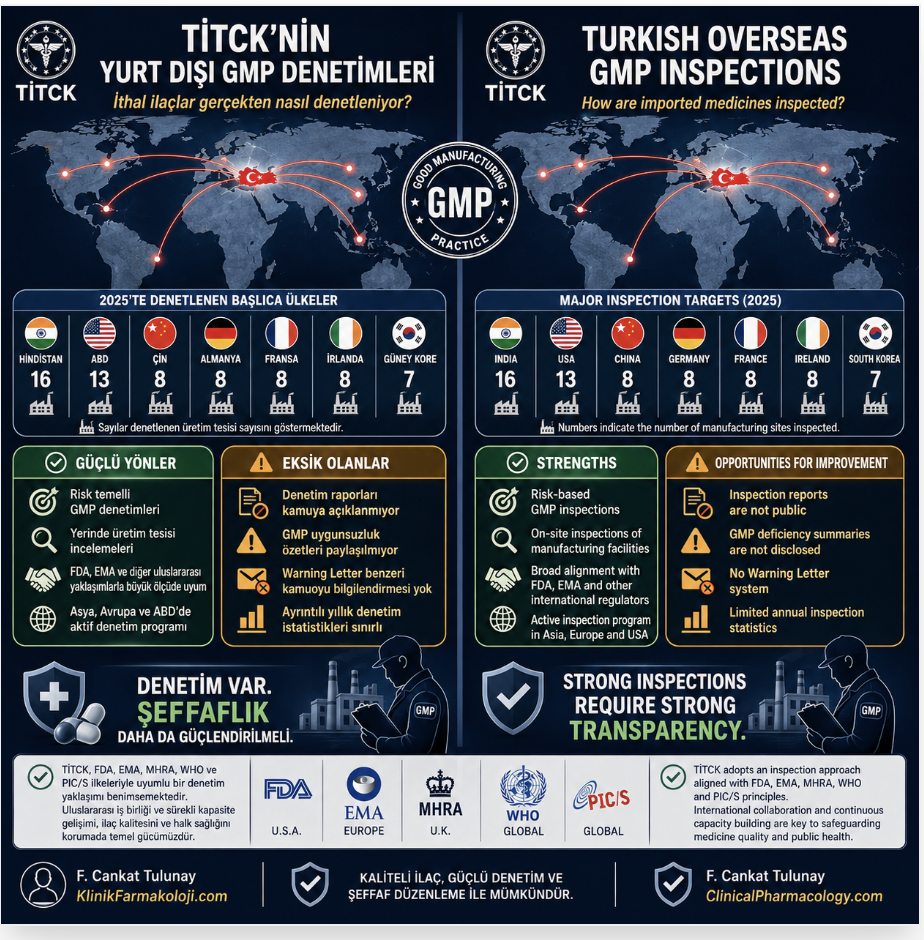
Regulatory Oversight Beyond Borders: Foreign GMP Inspections of Imported Medicines in Türkiye
Prof. Dr. F. Cankat Tulunay
Abstract
Background. The globalization of pharmaceutical manufacturing has shifted the production of active pharmaceutical ingredients (APIs) and finished products toward Asia, so that the quality of medicines consumed in importing countries increasingly depends on manufacturing facilities located abroad. Foreign Good Manufacturing Practice (GMP) inspection is therefore central to pharmaceutical quality assurance, yet the foreign GMP inspection activities of many national regulators, including Türkiye's, have received limited scholarly attention.
Methods. This descriptive study analysed publicly available regulatory information on foreign GMP inspections performed by the Turkish Medicines and Medical Devices Agency (TİTCK). The principal dataset comprised the official TİTCK lists of overseas manufacturing facilities inspected during 2017–2020 and, subsequently, 2024 and 2025. TİTCK's approach was compared with the frameworks of the FDA, EMA, MHRA, WHO and PIC/S, focusing on legal authority for overseas inspection, risk-based inspection planning, reliance on foreign inspection reports, publication of inspection outcomes and regulatory transparency. Only official documents and English-language literature in the public domain were used.
Results. TİTCK conducts an active, risk-based overseas GMP inspection programme spanning major manufacturing countries across Asia, Europe and North America. The 2025 programme included inspections in India (16 facilities), the United States (13), Germany, France, Ireland and China (8 each) and the Republic of Korea (7), among others. Chinese inspections covered both APIs and biological products. Detailed inspection findings, deficiency summaries and prioritization criteria were not publicly disclosed, limiting independent evaluation of inspection outcomes.
Conclusions. Türkiye maintains a functioning foreign GMP inspection capability consistent with international regulatory principles. Enhancing transparency—through periodic publication of inspection statistics and anonymized deficiency summaries—together with continued investment in inspection capacity, inspector training and international regulatory cooperation would further strengthen the scientific credibility of, and public confidence in, the quality of imported medicines.
Keywords: Good Manufacturing Practice; foreign GMP inspection; pharmaceutical regulation; medicines quality; regulatory transparency; reliance; imported medicines; Türkiye.
Introduction
The globalization of pharmaceutical manufacturing has profoundly transformed the production, regulation and quality assurance of medicinal products. During the past four decades, pharmaceutical manufacturing has progressively shifted from North America, Western Europe and Japan toward Asia, particularly China and India, which have become the world's principal suppliers of active pharmaceutical ingredients (APIs) and major manufacturers of finished pharmaceutical products. Consequently, the quality of medicines used worldwide increasingly depends on manufacturing facilities located outside the importing countries. (1–4)
Although globalization has substantially improved the availability and affordability of medicines, it has also created significant regulatory challenges. Modern pharmaceutical supply chains involve multiple manufacturers, contract manufacturing organizations, raw material suppliers and international distribution networks. Under these circumstances, ensuring consistent product quality has become increasingly dependent on effective international regulatory oversight rather than solely on national regulatory control. (1,2,5)
Unlike most industrial products, pharmaceutical quality cannot be guaranteed exclusively through finished-product testing. Analytical testing evaluates only predefined quality attributes of sampled products and cannot demonstrate that every stage of manufacturing consistently complies with Good Manufacturing Practice (GMP). Modern pharmaceutical regulation is therefore founded on the principle that quality must be built into the manufacturing process rather than tested into the finished product, making GMP inspections one of the most important regulatory tools for protecting public health. (1,2,6–8)
Contemporary GMP inspections extend well beyond verification of documentary compliance. They evaluate pharmaceutical quality systems, manufacturing operations, process validation, equipment qualification, laboratory controls, computerized systems, contamination control, supplier qualification, computerized data management, data integrity and management commitment to quality. Collectively, these elements determine whether a manufacturing facility is capable of consistently producing medicines that meet predefined quality standards. (2,6–10)
The globalization of pharmaceutical production has simultaneously transformed the responsibilities of regulatory authorities. Historically, regulatory agencies primarily focused on domestic manufacturers. Today, however, a substantial proportion of medicines marketed worldwide originates from foreign manufacturing sites. Consequently, overseas GMP inspections have become an integral component of pharmaceutical regulation. Regulatory authorities including the U.S. Food and Drug Administration (FDA), European regulatory authorities and the Medicines and Healthcare products Regulatory Agency (MHRA) routinely perform inspections outside their national borders to verify compliance with internationally accepted GMP standards. (5,9–13)
China and India occupy a central position within the global pharmaceutical supply chain. China has become the world's leading producer of pharmaceutical raw materials, whereas India is currently the largest global supplier of generic medicines. Together, these countries manufacture pharmaceutical products distributed to virtually every major healthcare market. At the same time, inspection findings published by international regulatory authorities demonstrate that significant GMP deficiencies continue to occur in individual manufacturing facilities, particularly regarding data integrity, laboratory controls, pharmaceutical quality systems and process validation. These observations should not be interpreted as indicators of national manufacturing quality. Instead, they emphasize one of the fundamental principles of regulatory science: regulatory confidence should be established through evaluation of individual manufacturing facilities rather than assumptions based on country of origin. (10–17)
Türkiye has likewise become increasingly integrated into global pharmaceutical supply chains. Imported APIs and finished pharmaceutical products constitute an important component of the national pharmaceutical market, making foreign GMP oversight an essential element of pharmaceutical quality assurance. In response, the Turkish Medicines and Medical Devices Agency (TİTCK) has established regulatory procedures incorporating on-site foreign GMP inspections, document-based assessments and risk-based regulatory decision-making for overseas manufacturing facilities. (18–21)
Recently published TİTCK overseas GMP inspection lists for 2024 and 2025 further demonstrate the continuation and expansion of these inspection activities. The updated data indicate ongoing inspections across major pharmaceutical manufacturing countries in Asia, Europe and North America, supporting the implementation of a continuously evolving risk-based regulatory strategy. (21,22)
Despite the growing importance of foreign GMP inspections, relatively little attention has been paid to this subject within the Turkish scientific literature. Previous publications have predominantly focused on bioequivalence, analytical quality control, pharmacovigilance and post-marketing surveillance, whereas the regulatory evaluation of overseas GMP inspections has rarely been examined. The present study addresses this gap by reviewing international regulatory approaches to foreign GMP inspections and presenting the first systematic analysis of publicly available overseas GMP inspection data released by TİTCK for the period 2017–2020. The findings are discussed within the broader context of international regulatory science, with particular emphasis on imported pharmaceutical products originating from China and India. (18–25)
Materials and Methods (Revised with Vancouver citations)
Methods
Study Design
This study was designed as a regulatory science analysis integrating a narrative review of international Good Manufacturing Practice (GMP) inspection systems with an observational evaluation of publicly available foreign GMP inspection data released by the Turkish Medicines and Medical Devices Agency (TİTCK). Rather than assessing the GMP compliance of individual pharmaceutical manufacturers, the study evaluates regulatory strategies used by major authorities to assure the quality of imported medicines and compares these approaches with the publicly available Turkish foreign inspection program. (2–6)
The principal objective was to examine how foreign GMP inspections contribute to pharmaceutical quality assurance within increasingly globalized supply chains and to evaluate the publicly available overseas inspection activities conducted by TİTCK between 2017 and 2020. (5–8)
Data Sources
The study was based exclusively on publicly available regulatory documents, official guidance, inspection manuals, legislation and peer-reviewed scientific literature. No confidential inspection reports, unpublished regulatory documents or commercially sensitive information were used.
Primary regulatory sources included publications issued by:
– Turkish Medicines and Medical Devices Agency (TİTCK)
– U.S. Food and Drug Administration (FDA)
– European Medicines Agency (EMA)
– Medicines and Healthcare products Regulatory Agency (MHRA)
– Pharmaceutical Inspection Co-operation Scheme (PIC/S)
– World Health Organization (WHO)
– International Council for Harmonisation (ICH)
– National Medical Products Administration (NMPA), China
– Central Drugs Standard Control Organization (CDSCO), India. (1–13)
Scientific publications were identified through searches of PubMed, Scopus and Google Scholar using combinations of the following keywords:
"Good Manufacturing Practice", "foreign GMP inspection", "regulatory science", "pharmaceutical quality", "data integrity", "China pharmaceutical manufacturing", "India pharmaceutical manufacturing", "FDA inspection", "PIC/S", "regulatory transparency", "TİTCK". (6–15)
Only English-language publications and official regulatory documents directly related to pharmaceutical manufacturing and GMP inspection systems were included.
Evaluation of International Regulatory Systems
The regulatory approaches adopted by FDA, EMA, MHRA, WHO, PIC/S and selected Asian regulatory authorities were reviewed comparatively.
The comparison focused on:
– legal authority for overseas GMP inspections;
– inspection planning methodology;
– risk-based inspection strategies;
– reliance on foreign inspection reports;
– publication of inspection outcomes;
– management of critical GMP deficiencies;
– regulatory transparency;
– international cooperation mechanisms. (2–12)
FDA documentation received particular emphasis because of the extensive experience of the Agency in overseas pharmaceutical inspections and the availability of inspection-related regulatory information, including Warning Letters, Import Alerts and data integrity guidance. (8–11)
Evaluation of the Turkish Foreign GMP Inspection Program
Publicly available TİTCK documentation concerning foreign GMP inspections was systematically reviewed.
The principal dataset consisted of the official list of overseas pharmaceutical manufacturing facilities inspected by TİTCK during the period 2017–2020. (18–20)
Whenever available, the following variables were extracted:
– country;
– inspection year;
– manufacturing site;
– inspected manufacturing activities;
– dosage forms;
– manufacturing scope.
Countries were subsequently classified according to geographical region to facilitate descriptive comparison of inspection activity.
Because publicly available documents do not disclose detailed inspection findings, the analysis focused on inspection activity rather than inspection outcomes. Accordingly, the study evaluates inspection strategy and regulatory transparency rather than the GMP compliance status of individual manufacturers. (18–20)
Comparative Regulatory Analysis
To place the Turkish foreign inspection program into an international regulatory context, qualitative comparison was performed between TİTCK and three mature regulatory systems:
– FDA
– European regulatory authorities
– MHRA
The comparison evaluated:
– foreign inspection strategy;
– implementation of risk-based inspections;
– publication of inspection statistics;
– availability of inspection findings;
– transparency of regulatory communications.
The objective was not to rank regulatory agencies but to identify common regulatory principles and areas in which regulatory practices differ. (5–13)
The present comparison should therefore not be interpreted as a ranking of regulatory authorities. Each regulatory agency operates within its own legal framework, available resources and public health priorities. Rather, the comparison aims to identify common regulatory principles and to highlight opportunities for strengthening transparency and international regulatory cooperation. (2–13)
Regulatory Transparency Assessment
An additional analysis examined the availability of publicly accessible information concerning foreign GMP inspections.
The assessment included the availability of:
– inspection statistics;
– inspected countries;
– inspected manufacturing facilities;
– inspection reports;
– summaries of GMP deficiencies;
– annual regulatory reports;
– regulatory communications.
Transparency was evaluated solely from the perspective of publicly available information and should not be interpreted as a measure of regulatory quality or inspection effectiveness. (8–13,18–20)
Statistical Analysis
Because the objective of this study was descriptive rather than hypothesis-testing, no inferential statistical analyses were performed.
Categorical variables were summarized using frequencies and percentages whenever appropriate. Descriptive comparisons were performed to illustrate geographical distribution of inspections and differences among regulatory approaches adopted by major international authorities.
Future studies incorporating complete inspection databases may permit more sophisticated statistical analyses, including temporal trend analysis, inspection density according to manufacturing volume and correlation between inspection frequency and pharmaceutical import patterns.
Study Limitations
Several limitations should be acknowledged.
First, the analysis relied exclusively on publicly available regulatory information. Confidential inspection reports, internal regulatory correspondence and non-public GMP findings were unavailable and therefore outside the scope of the study.
Second, the study evaluated regulatory systems rather than individual pharmaceutical manufacturers. Consequently, the findings should not be interpreted as evidence regarding the GMP compliance status of any particular manufacturing facility.
Third, the primary dataset analysed in this study consisted of publicly available documentation covering the period 2017–2020. During preparation of the revised manuscript, official overseas GMP inspection lists for 2024 and 2025 also became publicly available and were incorporated where appropriate. Nevertheless, detailed inspection reports, inspection findings and regulatory outcomes remain unavailable, limiting comprehensive evaluation of inspection effectiveness and long-term inspection trends. (21,22)
Finally, this study focuses on pharmaceutical regulatory science. Economic, commercial and geopolitical aspects of global pharmaceutical manufacturing were considered only where directly relevant to regulatory oversight and pharmaceutical quality assurance. (2–6)
Results
Overview of TİTCK Foreign GMP Inspection Activities (2017–2020)
The publicly available foreign GMP inspection database released by the Turkish Medicines and Medical Devices Agency (TİTCK) provides the first opportunity to examine the geographical distribution and scope of overseas GMP inspections performed by the Turkish regulatory authority. The published data cover inspections conducted between 2017 and 2020 and include pharmaceutical manufacturing facilities located in Asia and Europe. (18–20)
The inspections encompassed a broad spectrum of pharmaceutical manufacturing activities, including manufacturers of active pharmaceutical ingredients (APIs), finished pharmaceutical products, sterile medicinal products and other pharmaceutical manufacturing operations. The diversity of inspected manufacturing activities demonstrates that the Turkish overseas inspection program was not restricted to a single product category but covered manufacturers supplying different pharmaceutical products to the Turkish market.
Although the publicly available database does not disclose detailed inspection outcomes or GMP deficiencies, it provides sufficient information to evaluate the geographical distribution of inspections and the general characteristics of the overseas inspection program.
Geographic Distribution of Overseas Inspections
Analysis of the published inspection list demonstrates that overseas GMP inspections were performed in several countries representing major pharmaceutical manufacturing regions.
Recently published official TİTCK overseas GMP inspection lists for 2024 and 2025 demonstrate that overseas inspection activities have continued beyond the 2017–2020 period. According to the 2025 inspection programme, inspections were performed in India (16 manufacturing facilities), the United States (13), Germany (8), France (8), Ireland (8), China (8), the Republic of Korea (7), Italy (6), Switzerland (5) and Spain (5). These updated data indicate that the Turkish overseas GMP inspection programme currently covers major pharmaceutical manufacturing countries across Asia, Europe and North America, reflecting an expanded and continuing risk-based inspection strategy. (21–24) 2. BUNU DEĞİŞTİRİN
Inspection activities were identified in China and several European countries, including Germany, France, Italy and Spain. These countries represent different regulatory environments and pharmaceutical manufacturing capacities. European manufacturers operate within the harmonized European Union GMP framework and are routinely inspected by their respective National Competent Authorities, whereas Chinese manufacturers are regulated by the National Medical Products Administration (NMPA) and constitute an important source of pharmaceutical raw materials and finished products for global markets. (5–17)
The geographical distribution indicates that TİTCK adopted an international inspection strategy extending beyond neighbouring countries and involving manufacturers located in multiple regulatory jurisdictions.
The updated 2025 inspection programme further broadens this geographical perspective by demonstrating inspection activity in India, the United States and the Republic of Korea in addition to previously inspected European countries and China. These observations suggest progressive expansion of overseas GMP inspection activities in response to changing pharmaceutical supply chains and regulatory priorities. (21,22)
Overseas GMP Inspections Conducted in China
Among the publicly available inspection records, China represented one of the principal overseas inspection destinations.
The official inspection list documents 12 pharmaceutical manufacturing facilities located in China that underwent on-site GMP inspection during the period 2017–2020. These inspections involved different pharmaceutical manufacturing activities, including API production, finished pharmaceutical products and other manufacturing operations. (18–20)
More recent official inspection lists published by TİTCK indicate that overseas inspections in China continued beyond the original study period. In the 2025 inspection programme, eight Chinese manufacturing facilities were included, confirming that China remains one of the principal destinations for Turkish overseas GMP inspections. These observations further support the strategic importance of China within the Turkish pharmaceutical supply chain. (21,22)
The ability of TİTCK inspectors to conduct overseas inspections in China demonstrates that Türkiye possesses operational experience in evaluating manufacturing facilities located within one of the world's largest pharmaceutical manufacturing countries.
Nevertheless, interpretation of these findings requires consideration of the size of the Chinese pharmaceutical industry. China hosts several thousand pharmaceutical manufacturers producing APIs, intermediates, biological products and finished medicinal products. Consequently, the inspection of 12 publicly reported facilities represents only a small proportion of the total manufacturing capacity potentially supplying international pharmaceutical markets.
This observation should not be interpreted as evidence of insufficient regulatory oversight. Rather, it reflects a fundamental characteristic of modern pharmaceutical regulation: no medicines authority possesses sufficient human and financial resources to inspect every foreign manufacturing facility. Accordingly, overseas inspection programmes are necessarily based on risk prioritization rather than comprehensive inspection of all manufacturers.
The updated inspection programme also demonstrates that inspection frequency should not be interpreted as a surrogate marker of manufacturing quality. Instead, inspection priorities are determined through risk-based regulatory planning that considers product characteristics, manufacturing complexity, previous compliance history, supply continuity and potential public health impact. (2–8,21–24)
Publicly Available Inspection Data from India
An important observation emerging from the analysis concerns India.
India is one of the world's largest manufacturers and exporters of generic medicines and active pharmaceutical ingredients and supplies pharmaceutical products to virtually every major healthcare market. Indian manufacturing facilities are routinely inspected by FDA, EMA, MHRA and numerous other regulatory authorities. (10–17)
The publicly available inspection list covering 2017–2020 did not include Indian manufacturing facilities. However, official TİTCK inspection lists published subsequently for 2025 demonstrate extensive overseas inspection activity in India, including sixteen manufacturing facilities. These updated data indicate that India has become one of the principal destinations of Turkish overseas GMP inspections. Therefore, the absence of Indian facilities in the earlier publicly available dataset should be interpreted as a limitation of the study period rather than evidence of inspection priorities or regulatory policy. (21–24) 3. BUNU EKLEYİN
This finding should be interpreted carefully.
The absence of Indian facilities from the publicly available database does not demonstrate that no regulatory oversight of Indian manufacturers was performed. Nor does it indicate that inspections were not conducted outside the publicly available dataset. Instead, it indicates that no inspections performed in India were included in the publicly released inspection list covering the study period.
From a regulatory science perspective, this observation raises important questions regarding inspection prioritization. Because the criteria used by TİTCK to select overseas inspection sites are not publicly available, it is not possible to determine whether inspection priorities were based primarily on product-specific risk, manufacturing complexity, import volume, previous compliance history or other regulatory considerations
Overseas Inspections in European Countries
The publicly available inspection list further demonstrates that overseas GMP inspections were conducted in several European countries, including Germany, France, Italy and Spain. These countries possess mature pharmaceutical regulatory systems, participate in PIC/S and implement harmonized European Union GMP requirements.
Manufacturing facilities located within these jurisdictions are routinely inspected by their own competent authorities and are subject to well-established regulatory oversight. The decision to perform additional inspections by TİTCK may therefore reflect product-specific considerations, manufacturer-specific factors or independent national regulatory requirements. However, the publicly available information does not permit evaluation of the regulatory rationale underlying individual inspection decisions.
In addition, regulatory agencies may prioritize inspections of manufacturing facilities producing sterile medicinal products, biological medicines, vaccines, highly potent active pharmaceutical ingredients or products considered critical for national medicine supply. Consequently, inspection frequency should always be interpreted within the broader context of regulatory risk management rather than as a simple indicator of manufacturing activity. (2–12,21–30)
Consequently, no conclusions can be drawn regarding the comparative priority assigned to European manufacturers relative to manufacturers located in other regions.
Assessment of Inspection Prioritization
One of the principal observations arising from the present study concerns the relationship between publicly available inspection activity and internationally accepted risk-based inspection principles.
Current international regulatory practice recommends that overseas inspections should be prioritized according to multiple risk indicators, including product type, manufacturing complexity, compliance history, previous inspection findings, supply chain importance and potential public health impact. (2–12)
The publicly available Turkish inspection data do not include information regarding the criteria used to determine inspection priorities. Consequently, independent evaluation of whether the geographical distribution of inspections fully reflected a risk-based inspection strategy is not possible.
This represents a limitation of publicly available information rather than a limitation of the inspection programme itself.
Indeed, mature regulatory authorities also maintain substantial amounts of confidential inspection information that cannot be disclosed because of legal obligations and the protection of commercially sensitive data. Therefore, limited public availability of inspection details should not automatically be interpreted as evidence of limited regulatory activity. (5–13)
Regulatory Transparency
The publication of overseas GMP inspection activities covering the period 2017–2020 represents an important contribution to regulatory transparency and provides researchers with valuable information concerning the implementation of Türkiye's foreign GMP inspection programme. (18–20)
The subsequent publication of inspection lists for 2024 and 2025 suggests a positive trend toward greater public availability of regulatory information. Continued publication of such information at regular intervals would further strengthen transparency and facilitate independent academic evaluation of overseas inspection strategies. (21,22)
However, comparable publicly available inspection datasets covering subsequent years could not be identified during the present review.
This finding should not be interpreted as evidence that overseas inspections were discontinued. Instead, it limits the ability of independent investigators to evaluate long-term inspection trends, inspection coverage, geographical priorities and changes in inspection strategy using publicly available information.
Publication of annual overseas inspection statistics and anonymized summaries of inspection activities would substantially improve the ability of researchers to evaluate regulatory performance while preserving confidential commercial information.
The publication of official overseas GMP inspection lists for both 2024 and 2025 represents an important improvement in regulatory transparency. Although detailed inspection findings remain confidential, the availability of updated inspection lists allows more accurate evaluation of geographical inspection coverage and inspection priorities over time. (21–24)
Discussion
The present study addresses an area that has received remarkably limited attention within the Turkish pharmaceutical literature: the contribution of foreign Good Manufacturing Practice (GMP) inspections to the quality assurance of imported medicines. While previous publications have predominantly focused on bioequivalence, pharmaceutical analysis, pharmacovigilance and post-marketing quality surveillance, considerably less attention has been devoted to regulatory oversight of overseas manufacturing facilities. This imbalance is noteworthy because pharmaceutical quality is established primarily during manufacturing and cannot be fully verified through testing of the finished product alone. (1–8)
Foreign GMP Inspections as a Public Health Instrument
The globalization of pharmaceutical manufacturing has fundamentally changed the responsibilities of national regulatory authorities. In countries where a substantial proportion of active pharmaceutical ingredients and finished medicinal products originate from foreign manufacturers, regulatory oversight can no longer be confined to domestic production facilities. Consequently, foreign GMP inspections have become an indispensable public health instrument rather than merely an administrative requirement associated with product registration. (2–8)
Unlike analytical testing performed after manufacturing, GMP inspections evaluate the systems responsible for consistently producing medicines of acceptable quality. They examine manufacturing practices, quality management systems, personnel training, laboratory operations, contamination control, computerized systems, deviation management and data integrity. These elements collectively determine whether pharmaceutical quality is reproducible throughout the product lifecycle. (2,5–10)
The present findings therefore support the widely accepted regulatory principle that pharmaceutical quality cannot be tested into a product after manufacturing has been completed. Instead, quality must be systematically incorporated into every stage of pharmaceutical production.
This principle has become increasingly important with the globalization of pharmaceutical manufacturing. Finished-product testing evaluates only a limited number of predefined quality attributes and cannot identify many deficiencies associated with manufacturing processes, quality culture, documentation practices or data integrity. Consequently, effective GMP inspections remain the cornerstone of pharmaceutical quality assurance worldwide. (1–10)
Risk-Based Regulation Does Not Eliminate the Need for On-Site Inspections
Virtually all mature regulatory authorities have adopted risk-based inspection strategies. Such approaches represent rational allocation of limited inspection resources and are now incorporated into regulatory practice by FDA, EMA, MHRA, PIC/S and WHO. (2–12)
However, an important distinction should be emphasized.
Risk-based inspection planning determines which manufacturing facilities should be inspected first; it does not imply that documentary assessment provides the same level of regulatory assurance as comprehensive on-site inspection.
Risk-based inspection strategies are intended to optimize the use of limited regulatory resources rather than to achieve comprehensive inspection coverage. Consequently, inspection frequency should not be interpreted as a direct measure of the quality of pharmaceutical manufacturing within a particular country. Instead, inspection priorities reflect multiple factors including product risk, manufacturing complexity, compliance history, import volume, supply-chain importance and potential public health impact. (2–7,21–24)
The updated TİTCK inspection lists published for 2024 and 2025 provide practical evidence of this principle. The predominance of inspections in India, together with continued inspections in China, the United States and major European manufacturing countries, suggests that overseas inspection priorities are periodically reassessed according to regulatory risk rather than geographical distribution alone. (21–24)
Document-based evaluation offers several advantages:
– more efficient use of regulatory resources;
– shorter regulatory timelines;
– reduced duplication of inspections;
– greater reliance on trusted regulatory partners.
Nevertheless, documentary review cannot independently verify several critical aspects of pharmaceutical manufacturing, including:
– implementation of pharmaceutical quality systems;
– manufacturing practices actually performed on the production floor;
– laboratory culture;
– personnel behaviour;
– undocumented deviations;
– data integrity practices.
Experience accumulated by FDA and other mature regulatory authorities demonstrates that many critical GMP deficiencies become apparent only during direct inspection of manufacturing facilities. (8–12)
FDA experience accumulated over several decades further demonstrates that serious GMP deficiencies continue to be identified in overseas manufacturing facilities despite advances in pharmaceutical quality systems. Data integrity violations, deficiencies in pharmaceutical quality systems, inadequate process validation and failures in contamination control remain among the most frequently reported inspection findings. These observations reinforce the continuing importance of direct on-site inspections as an indispensable component of pharmaceutical regulatory oversight. (24–26)
Accordingly, document-based assessment should be regarded as a complementary regulatory tool rather than a complete substitute for foreign GMP inspections.
Lessons from China and India
China and India illustrate both the opportunities and the challenges created by global pharmaceutical manufacturing.
Both countries have also implemented substantial regulatory reforms during the last decade. China's accession to the Pharmaceutical Inspection Co-operation Scheme (PIC/S) in 2023 represents an important milestone in the continued harmonization of its pharmaceutical inspection system with internationally accepted regulatory standards. India has likewise strengthened its GMP requirements and expanded regulatory oversight through revisions of Schedule M and increased inspection activities conducted by CDSCO. (23,29,30)
Both countries have established highly sophisticated pharmaceutical industries supplying medicines to virtually every regulated pharmaceutical market worldwide. Numerous manufacturers located in these countries consistently comply with international GMP standards and successfully undergo repeated inspections by FDA, EMA and other regulatory authorities. (13–17)
Updated TİTCK inspection data published for 2025 further demonstrate the dynamic nature of overseas inspection planning. India accounted for sixteen publicly reported inspections, China for eight, and the Republic of Korea for seven. These findings indicate that inspection priorities evolve according to regulatory needs, product portfolios, manufacturing complexity and supply-chain importance rather than reflecting permanent geographical preferences. (21–24)
At the same time, regulatory actions published by FDA demonstrate that significant GMP deficiencies continue to be identified in individual manufacturing facilities. Data integrity deficiencies, inadequate pharmaceutical quality systems, laboratory control failures and deficiencies in process validation remain among the most common observations reported during overseas inspections. (8–12)
These findings should not be interpreted as indicators of national manufacturing quality.
This distinction is particularly important because the pharmaceutical industries of China, India and the Republic of Korea differ substantially in manufacturing volume, product specialization and export profiles. Therefore, simple numerical comparisons of inspection frequency between countries may be misleading unless interpreted within the broader context of international pharmaceutical production and regulatory risk assessment. (21–30)
Similarly, the observation that China was inspected eight times and the Republic of Korea seven times in the 2025 programme should not be interpreted as indicating comparable pharmaceutical manufacturing capacity. China possesses one of the world's largest pharmaceutical manufacturing sectors, whereas the Republic of Korea has a substantially smaller but highly specialized industry with global leadership in biosimilars and biotechnology. Differences in inspection frequency therefore more likely reflect regulatory priorities and product-specific considerations than overall manufacturing capacity. (21–30) Likewise, the inspection of sixteen manufacturing facilities in India should not be interpreted as evidence of poorer manufacturing quality. Rather, it reflects India's position as one of the world's largest exporters of generic medicines and active pharmaceutical ingredients and its major role in supplying the Turkish pharmaceutical market. (16,17,21,22,30)
Rather, they reinforce one of the fundamental concepts of modern regulatory science:
Regulatory confidence should be established through evaluation of individual manufacturing facilities rather than assumptions based solely on country of manufacture.
This principle has become increasingly important as pharmaceutical supply chains continue to expand globally.
Implications for the Turkish Regulatory System
Türkiye has developed regulatory mechanisms enabling evaluation of overseas pharmaceutical manufacturers through foreign GMP inspections, document-based assessments and risk-based decision-making. The publicly available inspection information covering 2017–2020 demonstrates that TİTCK has accumulated practical experience in conducting foreign GMP inspections across multiple countries and manufacturing sectors. (18–20)
The updated inspection lists published for 2024 and 2025 further indicate that overseas inspection capability has been maintained and expanded. Inspection activities now encompass major pharmaceutical manufacturing countries responsible for the production of active pharmaceutical ingredients, biological medicines, vaccines and finished pharmaceutical products supplied to the Turkish market. (21,22)
The publication of these inspection activities represents an important contribution to regulatory accountability.
The subsequent publication of official overseas GMP inspection lists for 2024 and 2025 further strengthens this regulatory transparency. Together, these datasets demonstrate the continuity of TİTCK foreign GMP inspection activities and permit a more comprehensive evaluation of the geographical distribution of overseas inspections. (21–24)
Nevertheless, the present analysis also identifies opportunities for strengthening regulatory transparency.
At the time covered by the original dataset, publicly available information was primarily limited to inspections conducted between 2017 and 2020. Subsequently, official TİTCK inspection lists for 2024 and 2025 became publicly available, allowing partial assessment of recent inspection activities. Nevertheless, detailed inspection reports, inspection outcomes and summaries of GMP deficiencies remain unavailable, limiting independent evaluation of inspection effectiveness and long-term regulatory trends. (21–24)
Publication of inspection statistics and anonymized summaries of recurrent GMP deficiencies would facilitate independent scientific evaluation without compromising confidential commercial information.
Regulatory Transparency and Regulatory Maturity
International experience increasingly recognizes transparency as an essential component of regulatory maturity.
The availability of updated Turkish inspection lists for 2024 and 2025 represents a positive development in this regard. Although the level of publicly available information remains more limited than that provided by FDA, EMA or MHRA, publication of inspection lists enables independent assessment of inspection coverage and supports evidence-based discussion of regulatory policy. (21–28)
Regulatory transparency does not require disclosure of proprietary manufacturing information or confidential inspection reports. Instead, it involves publication of sufficient information to permit objective evaluation of regulatory performance.
Examples include:
– annual overseas inspection statistics;
– geographical distribution of inspections;
– inspection trends over time;
– anonymized summaries of common GMP deficiencies;
– regulatory performance indicators.
FDA, EMA and MHRA each publish different categories of inspection-related information consistent with their respective legal frameworks. (5–12)
Although the extent of publicly available information differs among regulatory authorities because of legal and administrative frameworks, international experience consistently demonstrates that greater regulatory transparency contributes to scientific evaluation, institutional credibility and public confidence without compromising commercially confidential information. (5–13,24–28)
Greater availability of comparable information would facilitate independent assessment of inspection activities while simultaneously strengthening institutional credibility and public confidence.
Greater transparency would also facilitate international benchmarking of regulatory performance. Periodic publication of overseas inspection statistics would enable comparison with other regulatory authorities while contributing to continuous quality improvement and strengthening confidence among healthcare professionals, industry and the public. (24–28)
Publication of anonymized summaries of recurrent GMP deficiencies, similar to the approaches adopted by FDA and several European regulatory authorities, would further strengthen transparency while maintaining the confidentiality of commercially sensitive information. Such reporting would also facilitate academic evaluation of inspection trends and contribute to continuous regulatory improvement. (24–28)
Strengths and Limitations of the Present Study
To our knowledge, this study represents the first systematic regulatory science evaluation of publicly available foreign GMP inspection activities conducted by TİTCK.
Unlike previous publications focusing primarily on GMP regulations or pharmaceutical manufacturing, the present study integrates international regulatory practice with publicly available Turkish inspection data.
Nevertheless, several limitations should be acknowledged.
The analysis relies exclusively on publicly available regulatory information. Consequently, confidential inspection reports, internal regulatory communications and unpublished inspection findings could not be evaluated.
Furthermore, publicly available Turkish inspection information was limited primarily to the 2017–2020 period. Therefore, the present study evaluates publicly available regulatory transparency rather than the entirety of overseas inspection activities conducted by TİTCK.
Despite these limitations, the findings provide an initial framework for evaluating Türkiye's foreign GMP inspection system within the broader context of international regulatory science and may contribute to future comparative regulatory research. (18–20)
Conclusion
The globalization of pharmaceutical manufacturing has fundamentally transformed the regulatory framework required to ensure the quality, safety and consistency of medicinal products. As pharmaceutical production has progressively shifted toward complex international supply chains, particularly those centered in China and India, national regulatory authorities have assumed responsibilities extending well beyond domestic manufacturing oversight. Foreign GMP inspections have consequently evolved from supplementary regulatory activities into essential components of modern pharmaceutical regulation. (1–8)
The present study demonstrates that pharmaceutical quality assurance cannot rely exclusively on product registration, bioequivalence studies or post-marketing laboratory testing. Although these regulatory instruments remain indispensable, they evaluate only selected aspects of pharmaceutical quality and cannot independently verify whether manufacturing systems consistently operate in compliance with Good Manufacturing Practice. International regulatory experience clearly indicates that pharmaceutical quality is primarily determined during manufacturing rather than after production has been completed. (2–10)
The findings further demonstrate that mature regulatory authorities, including FDA, EMA, MHRA and other PIC/S participating authorities, increasingly employ risk-based inspection strategies combined with international regulatory cooperation. Nevertheless, these authorities continue to regard comprehensive on-site inspections as the cornerstone of GMP verification. Documentary assessment, reliance mechanisms and international information sharing undoubtedly improve regulatory efficiency; however, they cannot fully evaluate manufacturing culture, implementation of pharmaceutical quality systems, laboratory practices, data integrity or management commitment to quality. These critical elements remain dependent upon direct observation during foreign GMP inspections. (5–13)
Accordingly, future regulatory strategies should seek to balance efficient use of international regulatory cooperation with the continued maintenance of independent national inspection capability, particularly for manufacturing facilities considered to represent higher regulatory risk. (2–13,23–28)
China and India illustrate the opportunities and challenges associated with the globalization of pharmaceutical manufacturing. Both countries possess internationally competitive pharmaceutical industries supplying medicines to virtually every major healthcare market. Simultaneously, inspection findings published by international regulatory authorities demonstrate that significant GMP deficiencies continue to occur in individual manufacturing facilities. These observations should not be interpreted as indicators of national manufacturing quality. Rather, they reinforce one of the fundamental principles of contemporary regulatory science: regulatory confidence should be established through independent evaluation of individual manufacturing facilities rather than assumptions based solely on country of origin. (8–17)
From the perspective of Türkiye, foreign GMP inspections represent an important component of national pharmaceutical quality assurance. The publicly available information analyzed in this study demonstrates that TİTCK has established a regulatory framework for overseas GMP inspections and has implemented inspection activities involving manufacturing facilities located in multiple countries. The publication of inspection activities covering the period 2017–2020 represents an important contribution to regulatory accountability and provides valuable insight into the implementation of Türkiye's foreign GMP inspection program. (18–20)
The recently published inspection programmes for 2024 and 2025 further demonstrate that overseas GMP inspections remain an active component of the Turkish regulatory system. The inclusion of manufacturing facilities located in India, China, the United States, the Republic of Korea and several European countries reflects continued implementation of risk-based regulatory oversight for imported medicines. (21,22)
However, the present analysis also identifies opportunities for strengthening regulatory transparency. Publicly available information describing overseas inspection activities after 2020 remains limited, restricting independent evaluation of long-term inspection trends and regulatory strategy. This observation should not be interpreted as evidence regarding the continuation or effectiveness of overseas inspections. Rather, it reflects the limitations inherent in evaluating regulatory performance exclusively through publicly available information. (18–20)
The publication of updated overseas GMP inspection lists for 2024 and 2025 represents an important step toward greater regulatory openness. Continued publication of annual inspection statistics together with anonymized summaries of recurrent GMP deficiencies would further strengthen scientific evaluation of the Turkish overseas GMP inspection programme while maintaining appropriate protection of commercially confidential information. (21–24)
International regulatory experience suggests that publication of annual inspection statistics, geographical distribution of inspections, anonymized summaries of recurrent GMP deficiencies and general regulatory performance indicators can strengthen institutional credibility while preserving confidential commercial information. Increased transparency also facilitates scientific evaluation, encourages continuous regulatory improvement and contributes to public confidence in medicines regulation. (5–13)
Future integration of Turkish overseas GMP inspection activities with broader international reliance and information-sharing mechanisms may further enhance regulatory efficiency while preserving the ability of TİTCK to perform independent risk-based inspections whenever considered necessary. (2,5,11,23)
The findings of this study have several implications for pharmaceutical regulation in Türkiye.
The availability of updated inspection information for 2024 and 2025 strengthens the evidence presented in this study by demonstrating that overseas GMP inspections continue to constitute an active component of the Turkish regulatory system. These updated data also provide a more comprehensive basis for evaluating inspection priorities and geographical coverage than was previously possible. (21,22)
First, foreign GMP inspections should continue to be regarded as one of the principal mechanisms for assuring the quality of imported medicines.
Second, risk-based inspection strategies should remain central to inspection planning while recognizing that document-based assessments cannot fully substitute for comprehensive on-site inspections.
Third, continued participation in international regulatory cooperation, information-sharing initiatives and reliance mechanisms should be encouraged, provided that these activities complement rather than replace national regulatory competence.
Finally, maintaining sufficient institutional capacity for independent foreign GMP inspections will remain essential as pharmaceutical supply chains become increasingly globalized and technologically complex. (2–13,18–20)
In conclusion, the quality of imported medicines depends not only on the compliance of pharmaceutical manufacturers with internationally accepted GMP standards but also on the scientific capacity, operational independence and regulatory maturity of the importing country's medicines authority. Strengthening foreign GMP inspection capacity, promoting evidence-based regulatory decision-making and enhancing appropriate regulatory transparency will remain critical to ensuring the continued quality, safety and reliability of medicines available to Turkish patients. (1–20)
Equally important will be continued investment in inspector training, international regulatory collaboration, implementation of contemporary data integrity standards and the routine publication of high-level inspection statistics. Collectively, these measures would further strengthen the scientific credibility, international recognition and regulatory maturity of the Turkish Medicines and Medical Devices Agency. (2–13,21–30)
As global pharmaceutical supply chains continue to evolve, maintaining a balanced approach that combines international regulatory cooperation, national inspection capability and appropriate regulatory transparency will remain essential for protecting public health and ensuring sustained confidence in the quality of imported medicines. (2–13,21–30)
The updated overseas GMP inspection data published by TİTCK for 2024 and 2025 strengthen the principal conclusions of this study by confirming that foreign GMP inspections remain an active regulatory activity covering major pharmaceutical manufacturing countries. These updated observations reinforce the importance of maintaining a transparent, science-based and risk-oriented overseas inspection programme as an integral component of pharmaceutical quality assurance in Türkiye. (21,22)
Future public reporting of annual inspection statistics, general categories of recurrent GMP deficiencies and trends in overseas inspection activities would further strengthen institutional transparency, facilitate independent scientific evaluation and enhance international confidence in the Turkish medicines regulatory system. (24–28)
Declarations
Ethics approval and consent to participate. Not applicable. This study analysed only publicly available regulatory documents and did not involve human participants, human data or animals.
Consent for publication. Not applicable.
Availability of data and materials. All data analysed in this study are derived from publicly available regulatory sources cited in the reference list, including the official overseas GMP inspection lists published by the Turkish Medicines and Medical Devices Agency (TİTCK).
Competing interests. The author declares that he has no competing interests.
Funding. This research received no specific grant from any funding agency in the public, commercial or not-for-profit sectors.
Authors' contributions. FCT conceived the study, collected and analysed the data, and wrote and approved the final manuscript.
Acknowledgements. None.
Abbreviations. API: active pharmaceutical ingredient; CDSCO: Central Drugs Standard Control Organization; EMA: European Medicines Agency; FDA: (US) Food and Drug Administration; GMP: Good Manufacturing Practice; ICH: International Council for Harmonisation; MHRA: Medicines and Healthcare products Regulatory Agency; NMPA: National Medical Products Administration; PIC/S: Pharmaceutical Inspection Co-operation Scheme; TİTCK: Turkish Medicines and Medical Devices Agency; WHO: World Health Organization.
References
1. World Health Organization. WHO good manufacturing practices for pharmaceutical products: main principles. WHO Technical Report Series No. 986, Annex 2. Geneva: WHO; 2014.
2. Pharmaceutical Inspection Co-operation Scheme. PIC/S Guide to Good Manufacturing Practice for Medicinal Products (PE 009). Geneva: PIC/S.
3. International Council for Harmonisation. ICH Q9(R1): Quality Risk Management. Geneva: ICH; 2023.
4. International Council for Harmonisation. ICH Q10: Pharmaceutical Quality System. Geneva: ICH; 2008.
5. European Commission. EudraLex Volume 4. EU Guidelines for Good Manufacturing Practice for Medicinal Products.
6. U.S. Food and Drug Administration. Pharmaceutical CGMPs for the 21st Century: A Risk-Based Approach. Silver Spring, MD: FDA; 2004.
7. U.S. Food and Drug Administration. Data Integrity and Compliance With Drug CGMP: Questions and Answers. Guidance for Industry. Silver Spring, MD: FDA; 2018.
8. U.S. Food and Drug Administration. Investigations Operations Manual. Silver Spring, MD: FDA.
9. U.S. Food and Drug Administration. Warning Letters Database. Silver Spring, MD: FDA.
10. U.S. Food and Drug Administration. Import Alert 66-40: Detention Without Physical Examination of Drugs From Firms Which Have Not Met Drug GMPs.
11. European Medicines Agency. Good Manufacturing Practice.
12. European Medicines Agency. Compilation of Union Procedures on Inspections and Exchange of Information.
13. Medicines and Healthcare products Regulatory Agency. GxP Data Integrity Guidance and Definitions. London: MHRA; 2018.
14. National Medical Products Administration. Drug Administration Law of the People's Republic of China.
15. National Medical Products Administration. Good Manufacturing Practice for Drugs.
16. Central Drugs Standard Control Organization. Drugs and Cosmetics Act, 1940 and Drugs and Cosmetics Rules, 1945.
17. Central Drugs Standard Control Organization. Good Manufacturing Practices and Requirements of Premises, Plant and Equipment for Pharmaceutical Products (Revised Schedule M). New Delhi: CDSCO.
18. Türkiye İlaç ve Tıbbi Cihaz Kurumu. Yurt Dışı Üretim Tesislerinin GMP Denetimleri İçin Yapılacak Müracaatlara Dair Kılavuz.
19. Türkiye İlaç ve Tıbbi Cihaz Kurumu. Kurumumuzca Yurt Dışı GMP Denetimi Yapılan Tesis ve Denetlenen Faaliyetlere Ait Liste (2017–2020). Ankara: TİTCK.
20. Sağlık Aktüel. TİTCK tarafından yurt dışı GMP denetimi yapılan tesis ve denetlenenfaaliyetlere ait liste (2017–2020). 29 April 2020.
21. Türkiye İlaç ve Tıbbi Cihaz Kurumu (TİTCK). Kurumumuzca Yurt Dışı GMP Denetimi Yapılan Tesis ve Denetlenen Faaliyetlere Ait Liste (2024). Ankara: TİTCK; 2024.
22. Türkiye İlaç ve Tıbbi Cihaz Kurumu (TİTCK). 2025 Yılında Kurumumuzca Denetlenmiş Yurt Dışı Üretim Tesislerinin Listesi. Ankara: TİTCK; 2025.
23. Pharmaceutical Inspection Co-operation Scheme (PIC/S). PIC/S Participating Authorities. Geneva: Pharmaceutical Inspection Co-operation Scheme. Available from: https://picscheme.org/en/members
24. World Health Organization. WHO Global Benchmarking Tool (GBT) for Evaluation of National Regulatory Systems. Geneva: World Health Organization. Available from: https://www.who.int/teams/regulation-prequalification/regulation-and-safety/pharmacovigilance/global-benchmarking-tools
25. U.S. Food and Drug Administration. Inspection Classification Database Search. Silver Spring, MD: U.S. Food and Drug Administration. Available from: https://www.accessdata.fda.gov/scripts/inspsearch/
Tables
Tables 1–7 are placed at the end of the manuscript. All tables were prepared by the author from publicly available regulatory sources.
Table 1. Publicly Reported Overseas GMP Inspections Conducted by TİTCK, by Country (2017–2025)
|
Country |
Publicly reported inspections* |
Main manufacturing activities |
|
India |
16 (2025) |
APIs, generic medicines, finished products |
|
United States (incl. Puerto Rico) |
13 (2025) |
Biological products, sterile products, finished products |
|
China |
12 (2017–2020); 8 (2025) |
APIs, finished products, packaging, quality control |
|
Germany |
8 (2025) |
Finished products, sterile products, biotechnology |
|
France |
8 (2025) |
Finished products, biological products |
|
Ireland |
8 (2025) |
Biological products, finished products |
|
Republic of Korea |
7 (2025) |
Biosimilars, biological products |
|
Italy |
6 (2025) |
Finished products, sterile products |
|
Switzerland |
5 (2025) |
Biological products |
|
Spain |
5 (2025) |
Finished products |
|
Other countries |
Remaining inspections |
Various |
*Based on publicly available TİTCK overseas GMP inspection lists.
Table 2. Regional Distribution of Publicly Reported Overseas GMP Inspections
|
Region |
Inspection activity |
Main manufacturing profile |
|
European countries |
High |
Finished products, sterile products, biotechnology |
|
Asia |
High |
APIs, generic medicines, biological products |
|
North America |
Moderate–High |
Biological products, vaccines, sterile products |
|
South America |
Low |
Finished pharmaceutical products |
|
Oceania |
Low |
Biological products |
Table 3. Comparison of China, India and the European Union
|
Parameter |
China |
India |
European Union |
|
Importance for global API supply |
Very High |
High |
Moderate |
|
Importance for global generic medicines |
Moderate |
Very High |
Moderate |
|
Publicly reported TİTCK inspections |
Yes |
Yes |
Yes |
|
PIC/S membership |
Applicant (since 2023) |
No |
Yes |
|
Mature regulatory authority |
Developing |
Developing |
Yes |
Table 4. Characteristics of the Chinese and Indian Pharmaceutical Industries
|
Characteristic |
China |
India |
|
Position in global pharmaceutical market |
World's largest API producer |
World's largest generic medicine exporter |
|
Active pharmaceutical ingredient production |
Very High |
High |
|
Finished pharmaceutical products |
Very High |
Very High |
|
Biological products |
High |
Moderate |
|
Vaccine production |
High |
High |
|
Principal regulatory authority |
NMPA |
CDSCO |
|
PIC/S membership |
Applicant (since 2023) |
No |
|
FDA foreign inspections |
Routine |
Routine |
|
Importance for Türkiye |
High |
High |
Table 5. Common Critical GMP Deficiencies Identified During International Inspections
|
GMP deficiency |
Typical regulatory finding |
Potential regulatory consequence |
|
Data integrity |
Missing, altered or unreliable records |
Loss of regulatory confidence |
|
Pharmaceutical Quality System |
Inadequate quality management |
Major GMP observations |
|
Laboratory controls |
Deficient analytical practices |
Product quality concerns |
|
OOS investigations |
Inadequate investigations |
Repeat observations |
|
Process validation |
Incomplete validation |
Manufacturing inconsistency |
|
Cleaning validation |
Cross-contamination risk |
Critical observations |
|
Sterility assurance |
Deficient aseptic processing |
High patient risk |
|
Computerized systems |
Inadequate audit trails |
Data integrity concerns |
|
Supplier qualification |
Weak supplier oversight |
Raw material quality risk |
Table 6. Publicly Available Information on the TİTCK Overseas GMP Inspection Programme
|
Parameter |
Publicly available information |
|
Overseas GMP inspection programme |
Yes |
|
Public list of inspected facilities |
Yes |
|
Countries inspected |
Yes |
|
Manufacturing activities |
Yes |
|
Detailed inspection reports |
No |
|
Inspection findings / outcomes |
No |
|
GMP deficiencies disclosed |
No |
|
Inspection prioritization criteria |
No |
|
Annual inspection statistics |
Limited |
|
Public inspection lists after 2020 |
Available for 2024 and 2025 |
Table 7. Comparison of Regulatory Transparency Among Major Medicines Authorities
|
Transparency indicator |
FDA |
EMA |
MHRA |
TİTCK |
|
Overseas inspections |
Yes |
Yes |
Yes |
Yes |
|
Risk-based inspection planning |
Yes |
Yes |
Yes |
Yes |
|
Publication of Warning Letters |
Yes |
— |
— |
— |
|
Statements of GMP non-compliance |
Yes |
Yes |
Yes |
— |
|
Publication of GMP deficiencies |
Yes |
Partial |
Partial |
No |
|
Import Alerts |
Yes |
— |
— |
— |
|
Annual inspection statistics |
Extensive |
Moderate |
Moderate |
Limited |
|
Public inspection database |
Extensive |
Partial |
Partial |
Limited |
|
Inspection reports |
Partial |
Partial |
Partial |
No |
|
Data integrity guidance |
Yes |
Yes |
Yes |
Partial |